
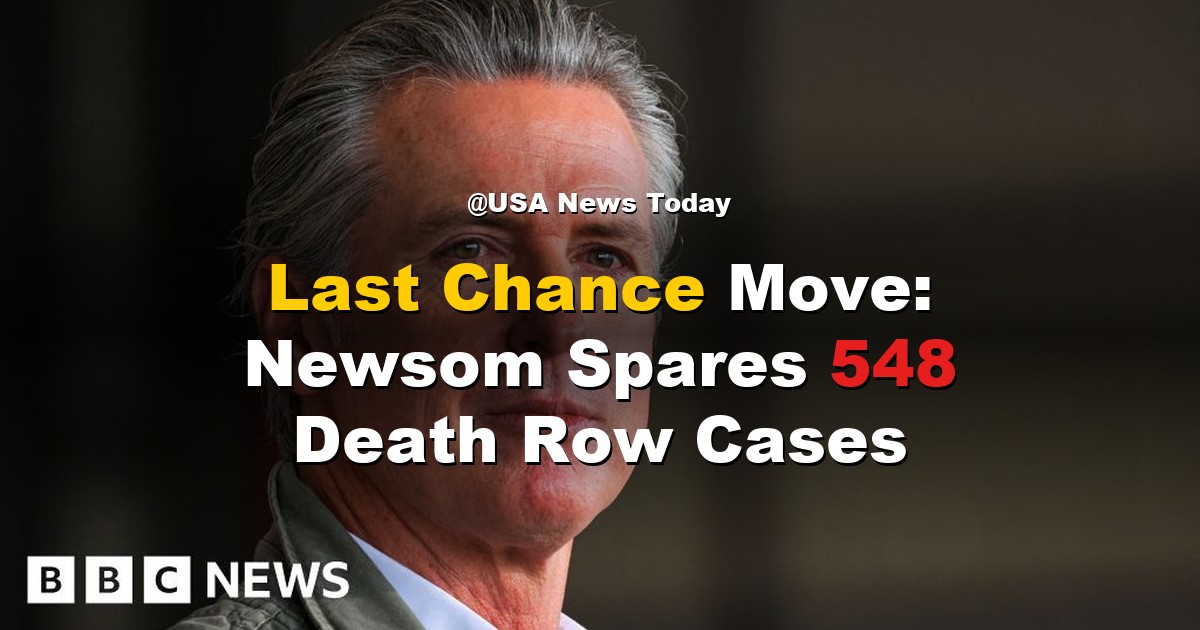
California Gov. Gavin Newsom announced he will commute the death sentences of all 548 people on the state’s death row, converting them to life imprisonment without the possibility of parole.
“We can now let these offenders die in obscurity while we forever remember and honour the victims,” Newsom said in a letter explaining the decision. He called the move difficult but “righteous,” arguing that California’s death-penalty system has failed by every measure and cannot be fairly applied.
According to the governor’s office, the action covers 529 men and 19 women currently under sentence of death. Officials stressed that no one is being released, pardoned, or made eligible for parole. Convictions and restitution orders remain in place. Sentences simply change from death to life without parole.
Newsom wrote that after nearly 30 years in public life he has concluded “state-sanctioned killing is incompatible with California’s values, undermines the foundations of our legal system and diminishes each of us.” He said he alone would bear responsibility for any execution and therefore felt compelled to follow his conscience.
The decision is partly practical as well as moral. California has not executed anyone since 2006, and only 13 people have been executed since voters reinstated capital punishment in 1978. Newsom imposed a moratorium in 2019, withdrew the lethal-injection protocol, and closed San Quentin’s execution chamber.
Not every commutation can be completed by the governor alone. Under the California Constitution, people with more than one felony conviction generally need a recommendation from at least four California Supreme Court justices before clemency can take effect. Newsom said he will send those cases to the court. Advocates warn that if the court does not act before he leaves office in early January 2027, some requests could lapse.
Death-penalty opponents called the announcement historic. Natasha Minsker, an anti-death-penalty advocate, said California holds about one-quarter of all U.S. death sentences and that emptying the row would be “by far the largest act of clemency” of its kind. ACLU Executive Director Anthony D. Romero said the commutations confront a “racist, error-prone, and inhumane punishment.”
Prosecutors were more critical. Los Angeles County District Attorney Nathan Hochman said that while Newsom has commutation power, only the Legislature or voters can abolish the death penalty outright. Californians have rejected abolition on statewide ballots twice, he noted.
The announcement comes as Newsom, who is termed out, is widely discussed as a possible 2028 presidential contender. Columbia University professor Bernard E. Harcourt said abolitionist stands by national candidates are rare in the U.S. but can sometimes be rewarded if voters see them as ethical leadership.
Families connected to condemned inmates described complicated emotions. Donna Larsen, whose son Keith Doolin has long maintained his innocence on a 1990s death sentence, said she was relieved the execution chamber would not be rebuilt even as the broader pain of the case remains. Victim advocates said the governor’s office is notifying survivors and next of kin as formal clemency paperwork moves forward.